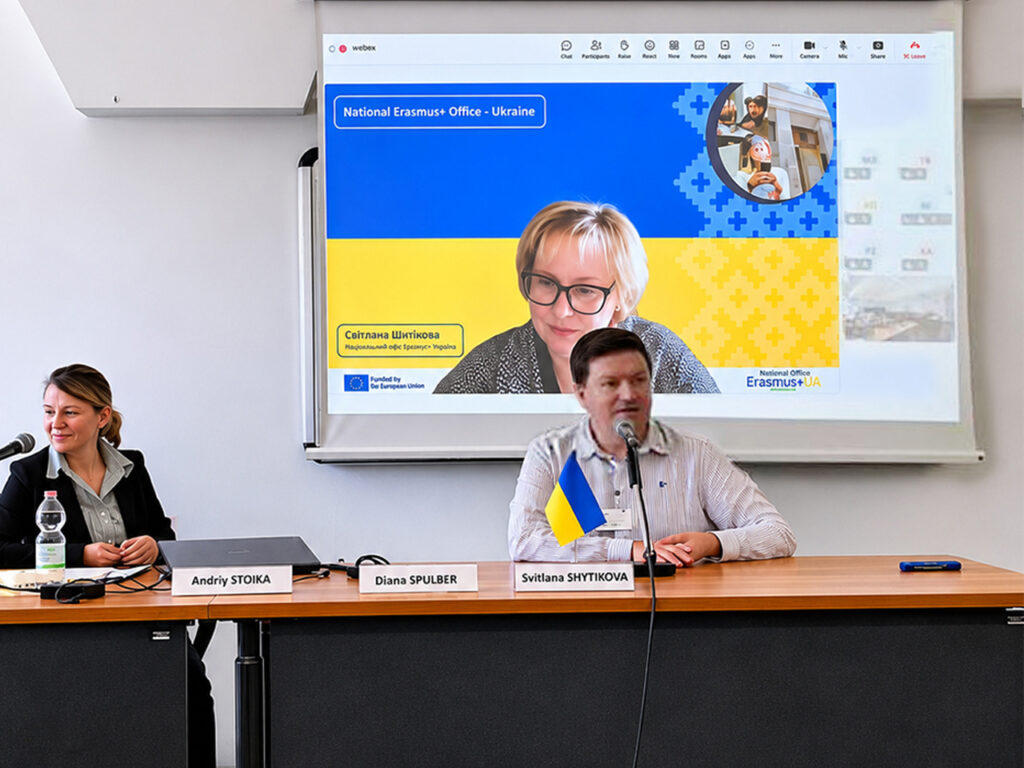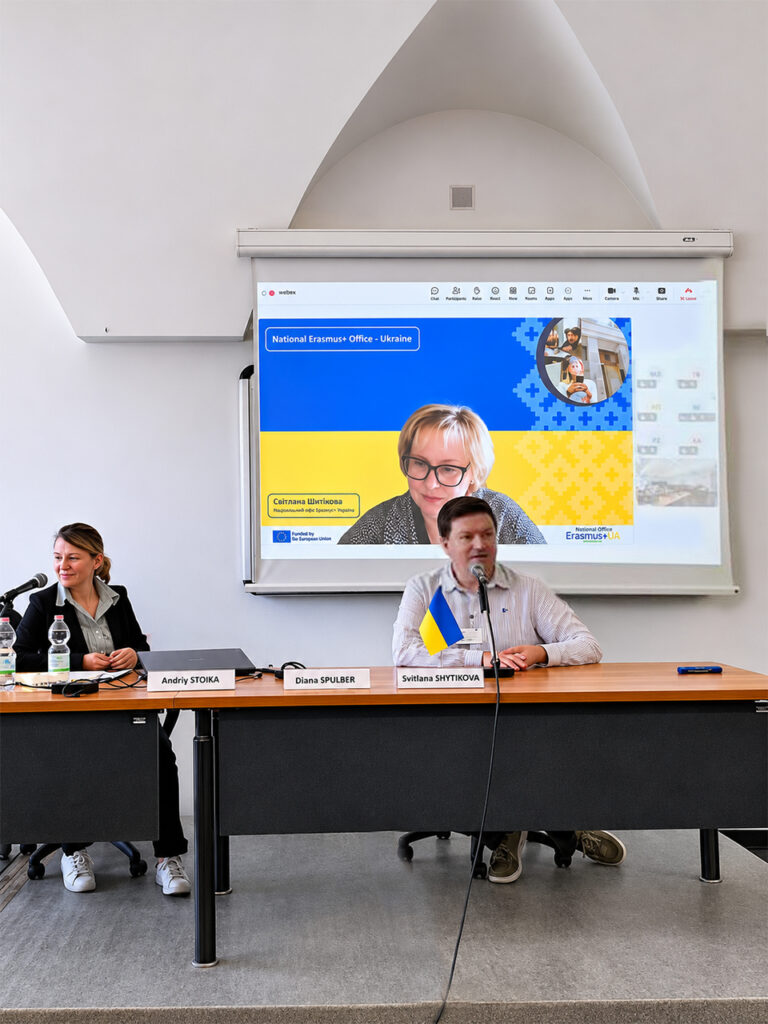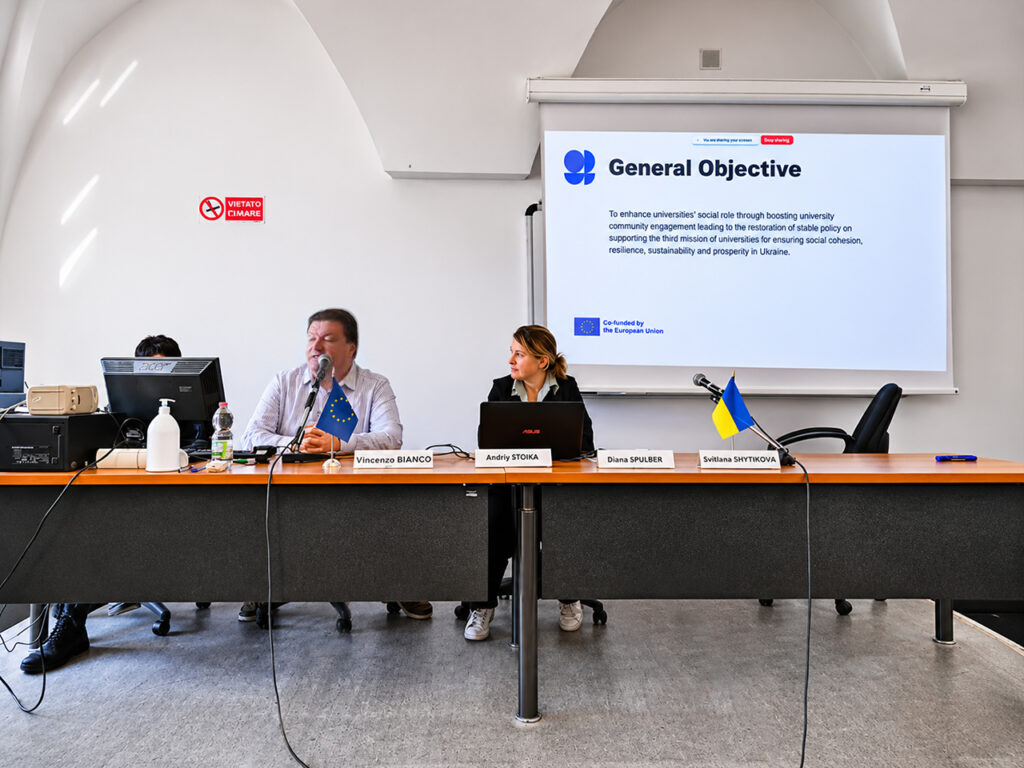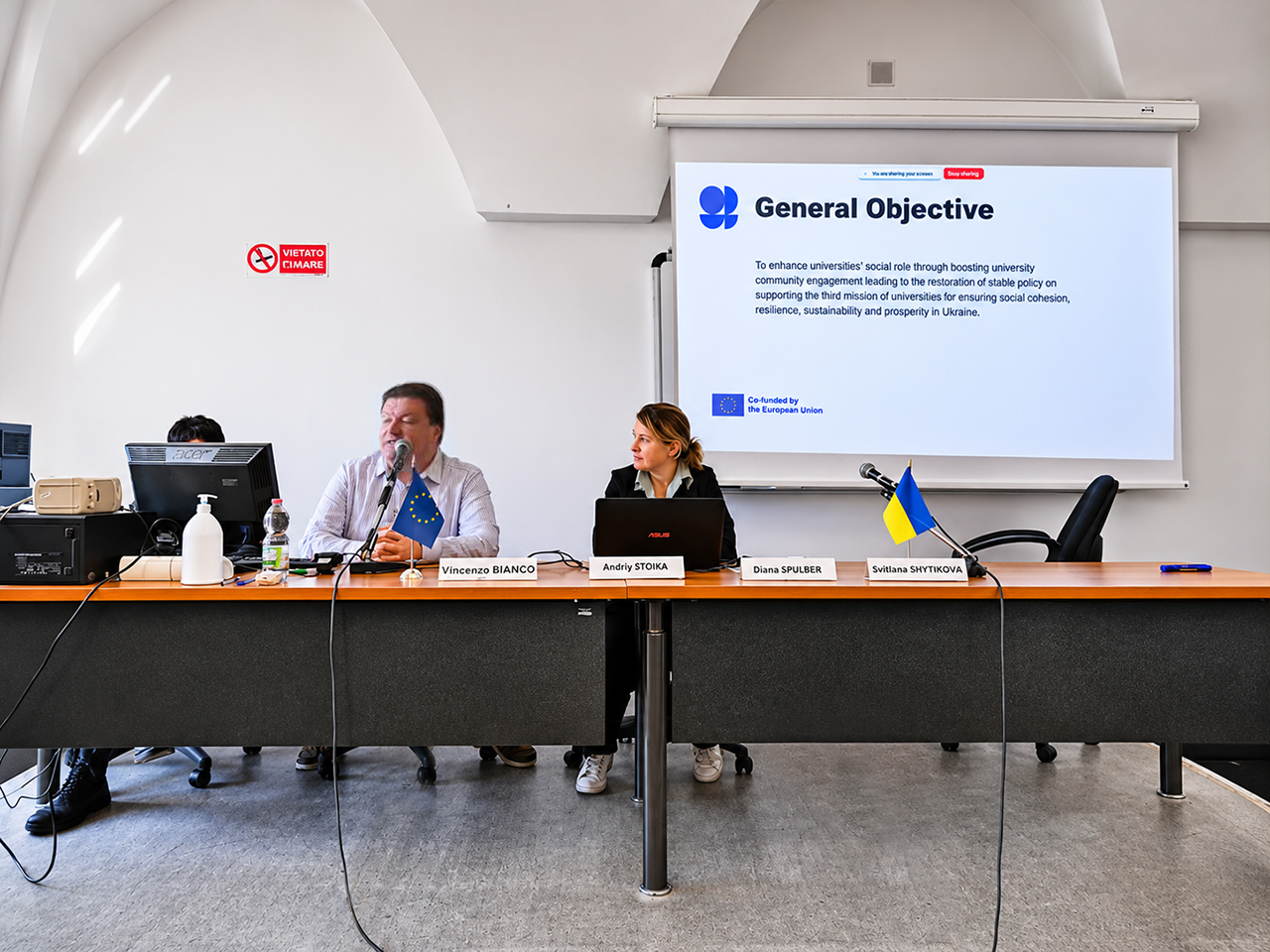
On 28–29 October 2026, the University of Genoa hosted the final dissemination conference of the international UKRENERGY project, where participants were introduced to the results of UNICOM. Particular attention was given to the development of a national methodology for assessing universities’ third mission and the potential use of Erasmus+ project results to support Ukraine’s recovery.
Professor Andriy Stoyka delivered a presentation entitled “Assessing Universities’ Societal Contribution: UNICOM Results and Synergy with UKRENERGY”. Professor Diana Spulber, the project manager, also contributed to the presentation and the subsequent discussion.
The presentation formed part of a knowledge-sharing session between Erasmus+ Capacity Building in Higher Education (CBHE) projects. This format provided an opportunity to share the project’s findings with partners from another international consortium and explore their potential application in energy efficiency, sustainable development and university–community engagement.
From Universities’ Societal Engagement to Recognition of Their Contribution
Introducing UNICOM, Andriy Stoyka outlined its main objective: to strengthen universities’ social role by developing cooperation with communities and approaches to public support for the third mission of higher education institutions.
The presentation considered the third mission as a systematic form of university engagement with society, drawing on knowledge, research capacity, educational opportunities and organisational resources to address community challenges. In Ukraine, this work has become particularly important through support for internally displaced people, veterans and communities, efforts to strengthen social resilience, and contributions to the country’s recovery.
Particular emphasis was placed on the gap between universities’ growing societal contribution and the mechanisms available to recognise and support it. Community engagement requires staff time, professional expertise and sustained resources, yet existing assessment mechanisms do not always fully capture its value.
One of the central questions of the presentation was therefore how to make universities’ societal contribution visible and demonstrable without reducing it to the number of activities undertaken.
Key UNICOM Results
Conference participants were introduced to the project’s research, policy and organisational outputs. The results highlighted in the presentation included:
- a research methodology for studying the third mission of higher education institutions and university–community cooperation;
- the study “Third Mission of Universities: Ukrainian and EU Approaches”;
- a policy paper on enhancing the third mission of universities in Ukraine, including relevant strategies and solutions;
- regulations on volunteering at Ukrainian higher education institutions;
- regulations on hackathons as a component of non-formal educational provision.
The presentation also introduced two interconnected areas of ongoing work: the draft Roadmap for Enhancing the Third Mission of Universities through Higher Education Reform in Ukraine and the draft National Methodology for Assessing Universities’ Third Mission.
These outputs seek to bring together European partners’ experience, Ukrainian university practices and community needs within a common framework for institutional development and national policymaking.
What Should Be Assessed?
Andriy Stoyka explained the rationale behind the proposed methodology. Its starting point is that the number of events, participants or partnership agreements indicates the scale of activity but does not, in itself, demonstrate societal impact.
Instead, assessment should help answer the question: what has changed for the community, and how has the university contributed to that change?
The presentation identified four interconnected dimensions of assessment:
- Institutional commitment. How societal engagement is embedded in the university’s strategy, governance and allocation of resources.
- Community engagement. How the university identifies societal needs and involves partners in shaping shared priorities.
- Implementation. How these priorities translate into services, initiatives, partnerships and knowledge exchange.
- Outcomes and impact. What changes for communities, and what evidence demonstrates the university’s contribution.
The proposed approach combines quantitative indicators with qualitative evidence, including case studies, feedback from partners and beneficiaries, interviews and documented outcomes.
An important element is consideration of each institution’s context: its mission, regional needs, displacement, wartime conditions and available resources. Common criteria should make assessment clear and consistent while allowing fair consideration of universities operating under different circumstances.
Independent Assessment, Institutional Accreditation and Incentives for Development
A separate part of the presentation addressed a possible national model for assessing universities’ third mission. Andriy Stoyka presented a proposal to incorporate this assessment into institutional accreditation as part of a comprehensive review of university activities.
Under the proposed model, institutional self-assessment would be complemented by independent expert review, including document analysis, stakeholder consultation and evaluation of evidence against published criteria. The presentation outlined a potential role for the National Agency for Higher Education Quality Assurance in organising this process.
Impartial expert selection, prevention of conflicts of interest, reasoned decisions, transparent criteria and an accessible appeals procedure were identified as essential safeguards for trust in the assessment.
The presentation also explored how verified results could support public recognition of universities, inform national rankings and improve funding mechanisms. These ideas were presented as proposals for further discussion and development.
Shared Opportunities for UNICOM and UKRENERGY
The presentation demonstrated how the two projects complement each other. UNICOM offers approaches to developing and assessing universities’ societal role, while UKRENERGY provides applied experience in energy efficiency, professional education and stakeholder cooperation for sustainable recovery.
This combination enables educational and technological outcomes to be considered in terms of their benefits for communities: responsiveness to local needs, stronger professional capacity, knowledge exchange and support for the green transition.
The presentation also outlined potential links with other Erasmus+ CBHE initiatives:
- INSPIRE — Institutional Accreditation for Sustainable Progress, Innovation and Excellence of Ukrainian Higher Education System towards European Integration, in relation to the potential use of third-mission findings in developing institutional accreditation criteria and pilot assessments;
- REVALUE — Social Value Reform Initiative for Impact-Based Next-Generation Higher Education Governance, in relation to measuring social value and using the findings in university governance.
These areas were presented as opportunities for further development and application of project outputs, subject to agreement between the partners.
Presenting UNICOM’s results at the UKRENERGY conference extended their reach and provided a basis for further professional dialogue on how university expertise, partnerships and international educational initiatives can support Ukraine’s recovery and deliver tangible benefits for communities.