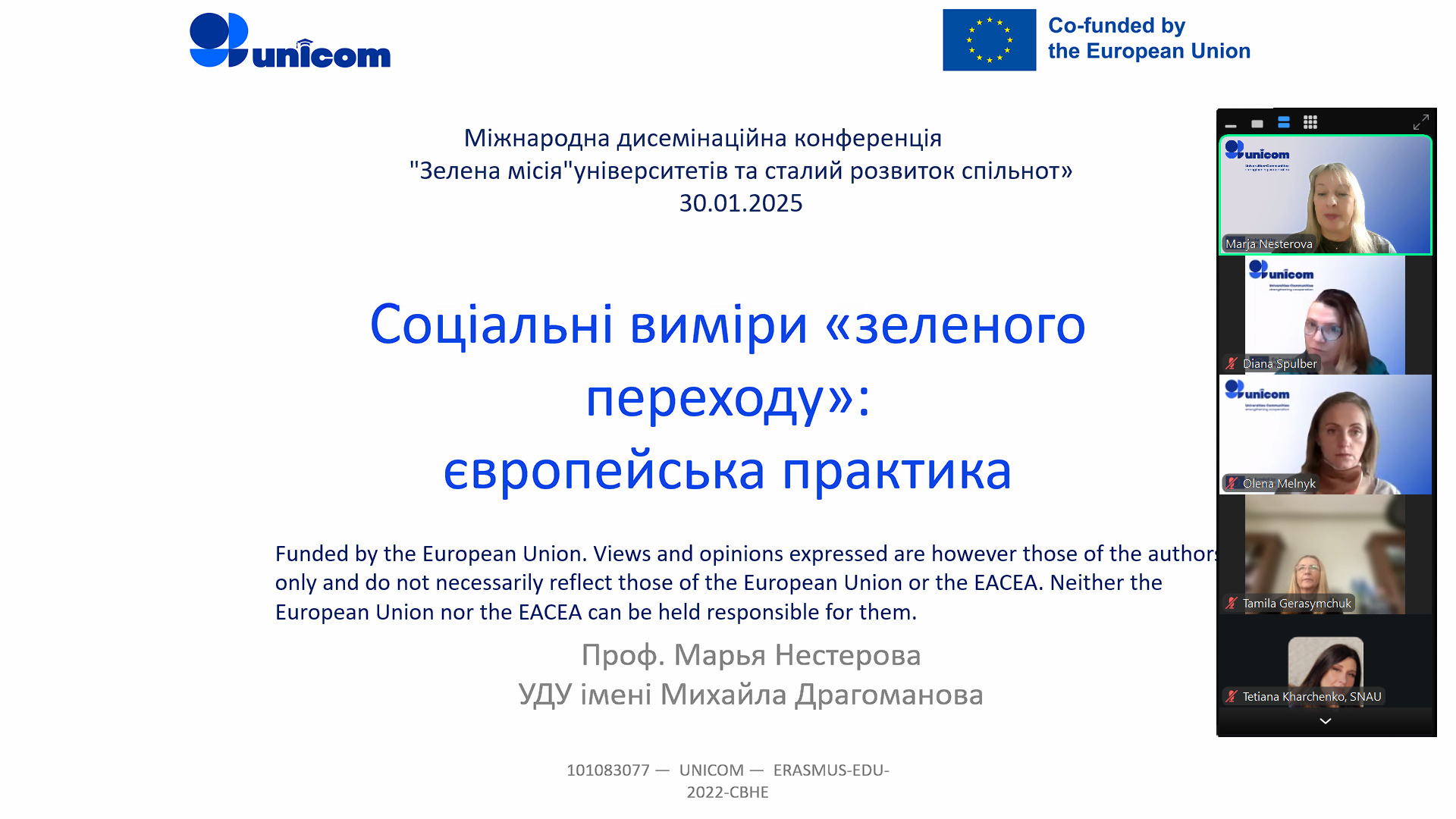
On 30 January 2026, an international dissemination conference titled “Green Mission of Universities and Sustainable Community Development” was held online within the framework of the Erasmus+ KA2 UNICOM project – “Universities – Communities: Strengthening Cooperation”.
The event served as a platform for professional discussion on the role of universities in the green transition, climate adaptation, sustainable community development, and Ukraine’s post-war recovery in the context of European Union policies. The conference brought together representatives of universities, researchers, academic staff, students, and community representatives.
The opening address and keynote presentation were delivered by Diana Spulber, who focused on the challenges of implementing the European Sustainable Development Goals in the activities of higher education institutions. In her presentation, she emphasised that universities play a key role not only as educational institutions but also as drivers of change in communities—through education, research, and their third mission.
“Resilience and sustainability must be embedded in university governance, educational programmes, and engagement with communities, rather than existing as separate initiatives,” the speaker stressed.
Professor Maria Nesterova, National Coordinator of the UNICOM project, presented a report dedicated to the social dimensions of the “green transition” and European practices for addressing them. She highlighted the risks of social inequality, the issue of a just transition, and the EU principle that “no one should be left behind.”
“The green transition is not only an environmental, but first and foremost a social transformation that requires trust in institutions, citizen participation, and clear communication,” Maria Nesterova emphasised.
A separate practical session of the conference was devoted to the issue of soils damaged as a result of the war. Olena Melnyk presented research results on soil contamination assessment, monitoring and remediation methods, as well as the university’s experience of cooperation with rural communities.
“High-quality data on soil conditions are the foundation for managerial decision-making, food security, and the recovery of agricultural territories,” the speaker noted.
Svitlana Lukash focused on the topic of Ukraine’s green recovery and new requirements for communities in the field of climate adaptation. Her presentation introduced the system of adaptation planning documents and emphasised that from 2026 onwards, the development of relevant strategies and plans will become mandatory for local self-government bodies.
“Climate change adaptation is not an additional burden for communities, but a tool for reducing risks and increasing resilience,” the speaker underlined.
The role of shelterbelts in achieving the objectives of the European Green Deal was presented by Svitlana Yaroshchuk. Her report highlighted the importance of protective plantings for climate adaptation, biodiversity conservation, water regime regulation, and soil protection.
“Shelterbelts are not a loss of agricultural land, but a long-term investment in soil fertility and crop stability,” the speaker stated.
Nataliia Volchenko dedicated her presentation to the interconnection between the European Green Deal, the Farm to Fork approach, and the right to adequate food. She emphasised that sustainable food system development must combine environmental requirements with social compensatory mechanisms in order to avoid negative impacts on vulnerable population groups.
“Sustainability without accessibility can lead to a social crisis; therefore, food policy must consider both environmental and social consequences,” the speaker stressed.
The final presentation was delivered by Nataliia Kapinos and focused on ecological networks as a spatial instrument for green territorial transformation. The presentation demonstrated how ecological corridors, protected areas, and green spaces form an ecological framework for territories and contribute to sustainable land use.
The conference marked an important stage in disseminating the results of the UNICOM project and contributed to deepening dialogue between universities and communities on the practical implementation of European approaches to the green transition and sustainable development.
The event was organised within the framework of the project 101083077 – UNICOM — ERASMUS-EDU-2022-CBHE, funded by the European Union. The views expressed are the sole responsibility of the authors and do not necessarily reflect the views of the EU or EACEA.